
Pedagogies of Professional Education End-of-Quarter Reflection
One of my assignments from my UW included a final portfolio. This assignment comprises four components:
Three weekly reflections: Choose three weekly reflections, and explain why I chose them.
Pedagogical self-reflection: A reflection on a conversation with a critical friend regarding the ‘what’ and ‘why’ of my work with learners.
Guiding pedagogical principles: Develop a set of principles that guide my work as a professional educator, and explain why they are important to my work.
Final reflection: Takeaways from this course and how they will inform my current and future practice.
Below is my final portfolio.
Weekly Reflections

I chose to draw from Weeks 1, 4, and 8 for this portfolio because these reflections center on the definition of ‘reflection’ itself, and show how my reflections evolved over the quarter. Katherine Liu’s (2015) article Critical reflection as a framework for transformative learning in teacher education pushed me to understand the role of ‘critical reflection’ in teacher education and broadened my definition to include the processes, content, and goals. For most of my life, I assumed reflection was only concerned with the ‘process’ (e.g., What went well with the lesson? What didn’t? What would I do differently next time).
My conceptualization of reflection was superficial relative to what scholars acknowledge. Either my reflections include one or two of the following: improving teaching processes, challenging social and political school policies and practices, or pursuing goals of enhanced learning. However, I often viewed these as isolated ‘lenses,’ and the umbrella of ‘critical reflection’ deepened my understanding of reflection.
Now, I find myself engaging with these elements more often, one of which has recently shifted toward challenging my assumptions about myself and the world.
Week 1 Reflection
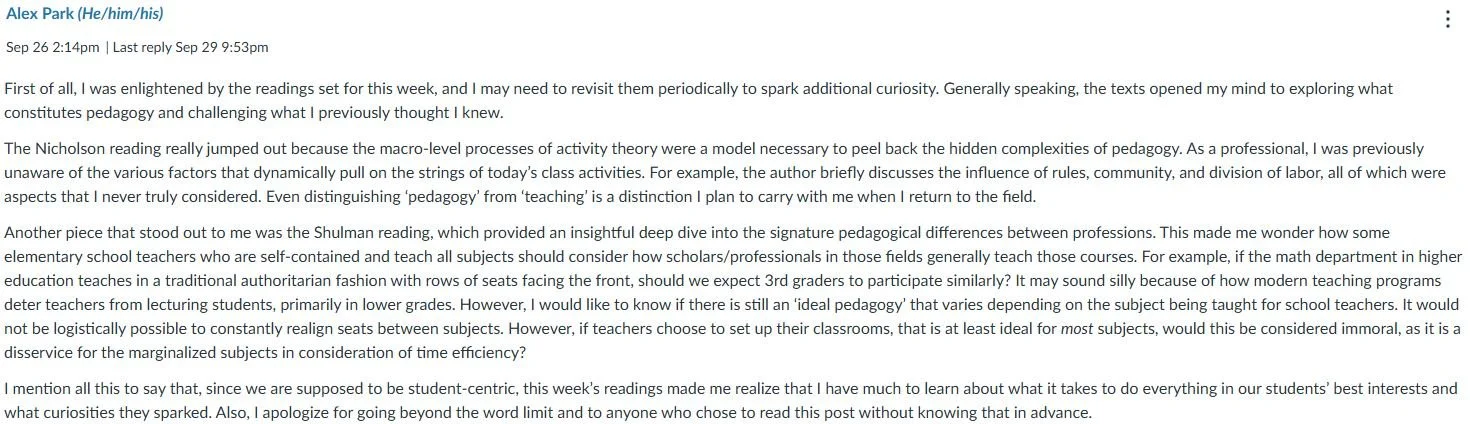

In week 1, my reflection did not reveal any hidden assumptions and mostly presented a modified understanding of what constitutes ‘pedagogy.’ While I abstractly identified a layer of a ‘goal’ when hypothesizing about the ‘ideal pedagogy’ for each subject, my critical reflection missed the mark in addressing assumptions about myself or the school environment.
Week 4 Reflection


In week 4, I stated in my reflection that I assumed reflection meant challenging my assumptions. This was actually a typo, and I meant that I only recently understood reflection as such from this quarter. However, there is also a notable shift in my response toward questioning power, an essential component of critical reflection. This change in tone delves into the ‘content’ and ‘goals’ necessary for critical reflection, one of which was not fully expanded on in the Week 1 reflection. After reviewing this reflection, I am beginning to see my ideas traveling back and forth between the important dimensions of critical reflection.
Week 8 Reflection
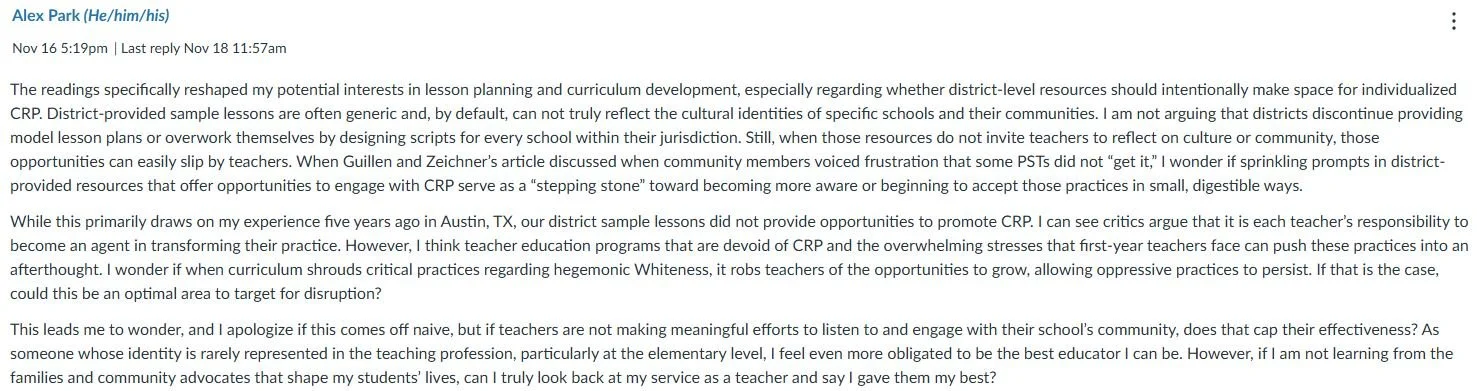
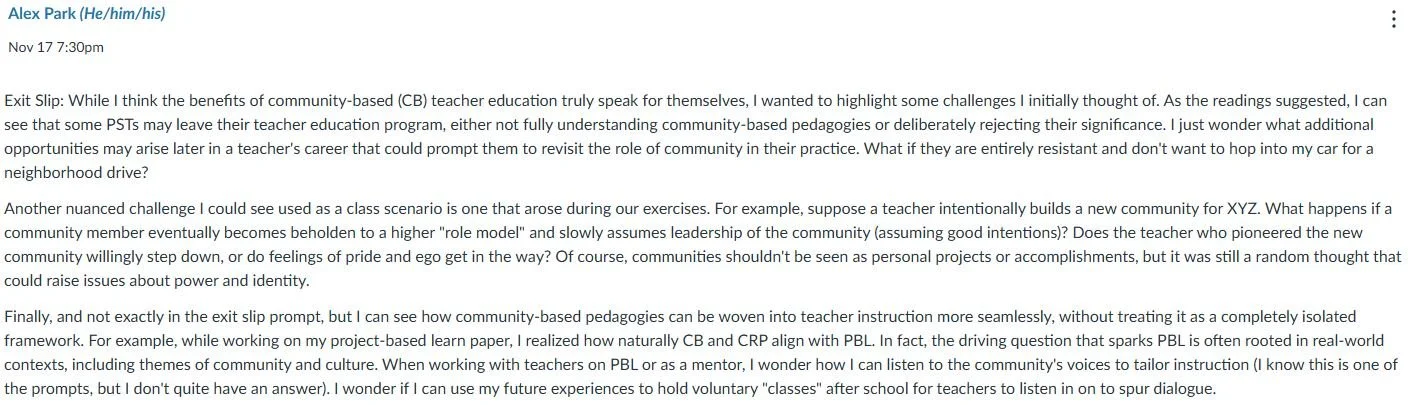
Lastly, with the week 8 reflection, there was a substantial effort to integrate the content from our readings with social justice-aligned goals and to question my assumptions. I noted a teacher’s ‘obligation’ to strive to become the best teacher they can possibly be, and how to create space in district-level resources for teachers to reflect on culturally responsive pedagogies, hopefully with critical consciousness.
Compared with the previous reflections, the thoughts have become more synchronized with the important dimensions of critical reflection. This deepening in responses is why I decided to focus on ‘reflection’ for this section.
Pedagogical Self-Reflection

In this section, we were instructed to engage in a ‘critical friend’ conversation about what we do and why we make our pedagogical choices. A colleague and I drew mainly from MacPhail et al.’s (2021) article, " The role of the critical friend in supporting and enhancing professional learning and development, which outlines the roles and responsibilities of a critical friend.
According to MacPhail et al., a critical friendship is defined by:
A reciprocal, collaborative relationship
A willingness to be challenged
Intrinsic motivation to engage in the work
Additional considerations of a critical friendship include:
Dedication of time and energy
Trust in the relationship
The ability to confirm and reject decisions
Be able to understand the context
During our conversation, we each drew on our guiding pedagogical principles (next section) and how they informed our approaches to teaching and learning.
For example, one of my core values is trust. My colleague asked whether I had any strategies for building trust with colleagues, and this took me by surprise. Although I believe trust between coworkers is important, I have spent all this time prioritizing learning to build trust with everyone else, including students, parents, and guardians.
This shifted my thoughts to how I can build trust with other professionals to cultivate a school culture of learning. This also led me to reflect on the potential influence of holding a doctoral title in school settings. A degree like this can carry social capital, build credibility, but also introduce tensions.
I began wondering about the possible power dynamics that could arise with the title, and how I could navigate them. My colleague posed what my ‘pedagogy of leadership’ would look like regarding schoolwide change, which again was something I had never considered.
Another meaningful part of our conversation was when my colleague asked why ‘being original’ was a core value in my teaching practice. I explained how I never had much representation in the elementary school teacher demographic as an Asian-American who identifies as male. I also elaborated on how the professions of many of my friends, who are Asian-American, were ‘decided’ for them by their parents. In a way, I like to “march to the beat of my own drum.”
Overall, the conversation was very reflective and insightful, and it built rapport between my colleague and me. Her questions pushed me to think about building trust with future colleagues, what could inform my leadership pedagogy, and how to navigate future challenges.
And while the conversation was more ‘supportive’ than ‘critical,’ I think there are opportunities in the future to move toward that as the foundations of trust, competence, and vulnerability are built.
Guiding Pedagogical Principles

Although not exhaustive, this section lists guiding principles that will guide my work as a professional educator.
Build Trust: Trust is foundational to teaching and learning. Students learn best when they are respected and safe in a space where they can take intellectual risks. It’s important to build trusting relationships with students, professionals, and parents and guardians.
Teach With an Inquiry Stance: All theories of knowledge are inherently subjective, while simultaneously characterized as varying degrees of objectivity. It is a moral obligation to approach teaching practices, school processes, and student learning with curiosity, to question, challenge, and reshape norms and understanding in education.
Engage in Ongoing Critical Processes: Transforming education requires engaging in critical reflection and critical consciousness. True, authentic use and understanding of these processes help analyze assumptions about personal identities, school structures, and education policies, to advocate for social and political justice and equity that support all learners.
Seek Professional Learning Communities: Finding like-minded peers or the trust of critical friends creates the momentum necessary for transformation. This is necessary to cultivate collegiality and foster a school culture of continuous learning.
Listen to Community Voices: There are whispers in the local community that often go unheard. A keen educator integrates community-based pedagogies to build trust, inspire students, and foster a mutual understanding of the cultural knowledge, values, beliefs, and experiences students bring into the classroom.
Never Stop Learning: Perfectionism is never the goal, but growth is. Effective teachers embrace lifelong learning by revisiting research-based practices, engaging in intensive, sustained professional development, and continuously seeking room to improve their craft. Teaching and learning cannot exist without the other.
Be Original: Although not often considered a principle, I believe originality is a mode of self-expression in the classroom that should not be overlooked. Being yourself is what makes the work of an educator fun and engaging despite its mess and challenges. My teacher program coordinator at UT once said that the most memorable teachers in our lives aren’t just about what or how well they taught, but who they were as people.
Final Reflection
In this final reflection, I will consider key takeaways from this course and how they will inform my future practices.
1. Questioning What I Already Know

In line with what was said previously, my first takeaway is questioning what I think I already know. I appreciated expanding on previously known concepts, such as reflection and modeling. Deepening my understanding of definitions such as ‘critical reflection’ and ‘explicit modeling with reflections and inquiry’ prompted me to reconsider and challenge what I had already assumed.
In a way, it’s not just about learning new content in my program, but also reshaping previously learned ones. Quite frankly, this seems to be a trend in educational research.
This affects my future teaching practice because, although I’ve made strides in learning toward becoming a more effective teacher, I view these gains as general directions on a map. While I may know the general direction, reshaping my learning feels like I am narrowing it to a specific degree of direction.
2. Staying Critical

My second takeaway from this class is the development of critical processes toward education. Besides critical reflection, we also learned about how ‘critical consciousness’ and ‘critical friends’ are often used to promote some kind of transformation.
For example, engaging with CRP requires more than just finding books that represent our student demographic, but also requires challenging power inequities in school structures. Not only do we examine our social identities and assumptions, but we also exploit them in the dominant culture to advance a sense of justice and equity.
This affects my future practice as someone interested in school curriculum. Before the quarter, I already knew to draw on students’ cultures in daily lessons to make them more meaningful.
However, I had never considered advocating for schoolwide change to reevaluate the school curriculum and learn how to navigate those challenges within school structures. In fact, two of my cohort members have already executed these changes, which I find quite inspiring.
Culturally responsive and community-based pedagogies, while well-intentioned, can be misaligned to create change. Celebrating other groups’ holidays is great, but it requires more than a surface-level understanding of the inequities that marginalized communities face. It requires thoughtful listening, criticality, and sometimes discomfort.
I do not want to be another “good teacher” with “good intentions” who misappropriates pedagogies. I want to stay critical, intentional, and equity-focused, and I hope to teach the students to think this way as well.
3. Pedagogies Overlap

As I revisit previously known pedagogies and learn about new ones, I see a lot of overlap among them. One of our class assignments asked us to write about any pedagogy of our choosing, and I picked ‘project-based learning’ (PBL).
While writing the paper, I noticed the interconnectedness between pedagogies. And I think this is important for three reasons:
Pedagogies are fluid.
Pedagogies should not be seen as isolated.
Pedagogies should be intentionally integrated.
While researching PBL, I began to notice a recurring theme of pedagogical fluidity. Scholars can often pin down what a specific pedagogy is not, but have difficulty defining what it definitively is. I think that’s also the beauty of its nature, because it allows educators to adapt pedagogical principles to their practices.
Because pedagogies are fluid, educators should not see them as completely isolated frameworks, as there is often overlap between them. For example, CRP and community-based pedagogies frequently intertwine because culture is closely tied to community. Both frameworks also form the basis of PBL, which requires a ‘driving question’ that often draws inspiration from real-world contexts.
Lastly, educators should be encouraged to integrate pedagogical principles intentionally, without diluting their core elements. Thinking of pedagogies as ingredients, some lessons (or recipes) require more of a specific ingredient than others. Other times, another ingredient will have a prominent role.
Regarding my future practice, I want to remain grounded in the fundamentals of pedagogical approaches, and never sacrifice ‘depth’ over ‘breadth.’ At the same time, there is a space that allows me to bring in other approaches to strengthen my practices.
Ultimately, when educators understand the essence of each pedagogy, I think integration can be a powerful way to transform classrooms and schools.
Closing Thoughts
My first quarter in the Ed.D. program at UW has been quite the start of a journey. There has been considerable intellectual stimulation, glimpses of future opportunities, and waves of inspiration. Even with its challenges, I believe the rest of my academic path will be worthwhile in the end.
I just have to remember to take it one day at a time.
