
Standard 6: Professional Learning and Development is Not So Black and White (Part 3)
In the third entry of the five-part series, I will review Standard 6: Professional Learning and Development.
This is an interesting standard, largely because it was one that I didn’t quite understand or grow to appreciate, really. In fact, I started to resent them early in my career.
Back when I was a teacher, I didn’t have many professional learning and development opportunities throughout the year. Most were jam-packed at the beginning of August before we started setting up our classrooms.
Since starting my program, I’ve learned that there’s another side to this. I’ve grown to appreciate how these opportunities can have a massive impact on teaching and learning, if done well.
Before reading the description of this standard, it was exactly what I imagined. Teacher educators and teachers should take opportunities to develop their craft and teach others.
Pretty standard stuff. Except, I now realize that professional learning and development is not black and white.
R.I.P. Hayden Panettiere - Sheryl Yoast in Remember the Titans (Aug 21, 1989 - Aug 16, 2026)
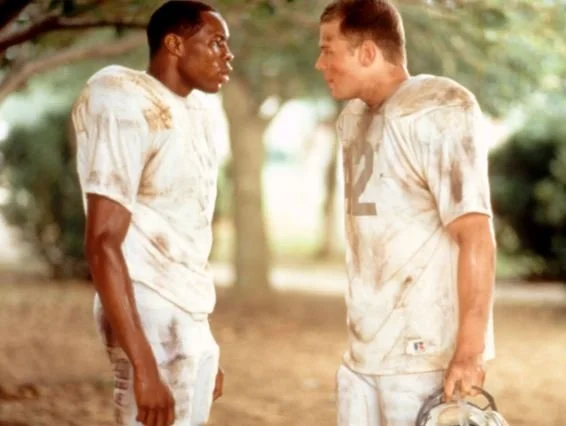
For this entry, I chose an image from Remember the Titans. The movie takes place after desegregation with a high school football team that recently integrated both Black and White players. The team had star players, worked on their plays, and had coaches in place. But they still weren’t a good football team.
Schools are similar. They can have experienced teachers, well-executed teaching strategies, and education leaders in place. But that doesn’t mean they are a good school.
There’s more to being a good player, professional, team, or school. It’s complicated.
For the Love of the Game
I remember being in class talking with my group about a new pedagogy. A classmate suddenly asked, “Are we doing this just to do it, or is there a purpose to it?”
It was a fair question. In fact, I think skepticism like this is important. Simply put, we shouldn’t do things as teachers just because we are told to. When certain ideas, practices, and pedagogies become normalized, they also become harder to question. Sometimes, we need to ask why.
But the question stuck with me.
The reason why I bring this up is that our professional learning and development opportunities ultimately need a purpose. I really like how Timperley (2008) really harps on this at the beginning of the booklet. Timperley says that professional learning activities are impactful when they center around student outcomes. What we do should be for the students.
I think that’s important because sometimes we lose sight of why we do things. We attend new trainings, learn new strategies, and implement new programs. But somewhere along the way, we forget why we do things.
That is something I want to take with me as I spend more time in this program. As I grow professionally, I need to continually ask myself: Why am I learning this? Is it the latest fad? Is it for myself? For the school? For the district? Or for the student?
“Are we doing this just to do it, or is there a purpose to it?”
As Timperley says, the purpose begins and ends with students. Professional learning should begin by asking what our students need and what we, as educators, can better address.
But if professional learning begins with our students, then wouldn’t most of my sessions have helped me? Surely most of them were “for the students,” right?
Whooo’s Got My Back? I Got Your Back!
This next part overlaps with Standard 9: Collegiality, Collaboration, and Partnerships, but I think it shows you how important the themes are.
Wood (2007) suggests that just designing learning around our students is not enough. Wood spent two and a half years following educators who underwent professional learning community initiatives to improve student learning. So, on paper, the purpose of these changes was “for the students.”
Still, Wood found most participants couldn’t connect their work to improved student learning. The district also wanted educators to take more responsibility for student learning, but they were also told how to spend their time during learning communities. The participants also reported stress due to time constraints.
While student outcomes give a purpose to professional learning and development opportunities, it’s not enough. Wood suggests that other conditions may need to be met, such as autonomy, inquiry skills, and time.
Strictly speaking, the purpose of football games is to win. But putting eleven players on the field isn’t enough.
In another study, Patton and Parker (2016) explored sustained communities of practice between physical education teacher educators. They found that the participants realized they developed a need for each other, felt less isolated, and began to recognize each other’s strengths.
Other conditions included a common focus, personal and professional relationships, safe yet challenging environments, and a shared commitment.
So, another theme centers on relationships. Strong, critical relationships are crucial. It pushes teammates to take more risks, rely on one another, and even disagree to achieve their goals. But safety and trust need to be in place.
Putting it all together, having the right conditions and strong relationships is essential. Like in Remember the Titans, having the right players, plays, coaches, and trust is necessary to play well together.
Hypothetically, if we designed the perfect professional learning opportunity with the shared purpose, the right conditions, and strong relationships, would that be enough…?
I thought it would be, but one author pushed me to consider one more thing we tend to overlook.
It was in front of us the whole time… well, if you’re facing a mirror.
Left Side! Strong Side!
To me, professional development follows a similar pattern. Teachers learn something new and then apply it. Korthagen (2017) shifted my thinking about this.
Korthagen argues that giving teachers the “right” knowledge will change how they behave in the classroom. But the problem is that this assumes that what we know always informs our actions. Through the hustle and bustle of a classroom, most of our decisions are actually made unconsciously.
Korthagen believes that we need to take our experiences, feelings, and motivations into consideration. This is also known as “gestalts.”
So, instead of teaching theory first in professional learning, Korthagen thinks we should start with teaching reflection. But a meaning-oriented reflection goes beyond what action can be done next time. Instead, we should be ourselves:
Why did I become upset?
What assumption was I making?
What were students experiencing?
What did they need?
What did I need?
Korthagen uses a model to show how professional learning can happen across different layers, including our environment, behavior, competencies, beliefs, identity, mission, and core qualities. He argues that better teaching comes from better alignment across all layers.
The reason I chose Remember the Titans is mainly because of what the movie centers on: changes in beliefs.
I’m not saying that every player participated in deep, meaningful reflections to change their beliefs, but for simplicity's sake, their beliefs changed.
In the movie, the turning point happens during the team’s summer training camp. Coach Boone forces the players to run to Camp Gettysburg and delivers an inspiring lecture on how they are fighting the same battle that the soldiers during the Civil War fought.
Julius Campbell (on the left) and Gerry Bertier (on the right) exchange words about how they need to get their stuff together. That night during practice, after Julius made a good play, Gerry shoved Julius and yelled, “Left side!” Julius initially interprets the act as an aggressive racialized attack, but realizes it was out of excitement and that Gerry was celebrating with him.
Julius responds by shoving back and yelling out, “Strong side!” The two go at it a few times as the whole team watches, the beautiful music cues, and you see the beginning of when the team finally comes together to play better once their beliefs start changing.
That’s a long-winded way of saying that I understand professional learning is not just about making us better professionals. As Standard 6 states, teacher educators are expected to enhance their personal performance and become “reflective and reflexive practitioners.”
Being a better educator also means looking inward.
Future Goals for Next Season
As for my place in education, I have to begin by recognizing that professional learning and development are for life. It also requires remembering why I’m doing what I’m doing, working with others for shared goals, building strong relationships, and working on myself as a person.
Before this program, I thought professional learning was something I had to do out of compliance. Now I see it's more complex.
So much more complex.
That doesn’t mean I’m suddenly going to love every mandatory workshop or annual training. In fact, I know I won’t.
But there’s also something I can do to engage with them more. Whether as a teacher, teacher educator, or some other rando who stumbled into the room, I want to consider important questions to ask, either out loud or to myself.
Are we doing this just to do it, or is there a purpose to it? Does this actually fit our context? What are the conditions in place? Who do I feel the safest around? Who do I trust to challenge me? What assumptions am I bringing?
And probably the hardest question: what do I need to change about myself?
References
Korthagen, F. A. J. (2017). Inconvenient truths about teacher learning: Towards professional development 3.0. Teachers and Teaching, 23(4), 387–405. https://doi.org/10.1080/13540602.2016.1211523
Kring-Schreifels, J. (2020, October 5). “Left side, strong side”: Remember the Titans at 20. GQ. https://www.gq.com/story/remember-the-titans-20-wood-harris-ryan-hurst
Patton, K., & Parker, M. (2017). Teacher education communities of practice: More than a culture of collaboration. Teaching and Teacher Education, 67, 351–360. https://doi.org/10.1016/j.tate.2017.06.013
Timperley, H. (2008). Teacher professional learning and development. International Academy of Education & International Bureau of Education.
Wood, D. R. (2007). Teachers’ learning communities: Catalyst for change or a new infrastructure for the status quo? Teachers College Record, 109(3), 699–739.
