
Standard 8: Bringing Balance to Teachers (Part 4)
For my fourth entry, I will focus on Standard 8: Mentoring and Coaching.
This is also a standard that I feel the most nervous about discussing. I don’t consider myself an experienced teacher, so the thought of mentoring or coaching someone else can feel a bit like the blind leading the blind.
At the same time, if we accept that even the most experienced teachers are still students, then perhaps it’s less about knowing it all and more about using what you know to help someone else grow.
Standard 8 describes mentoring and coaching as support for educators’ personal, professional, and pedagogical growth. That means building relationships, recognizing someone’s needs, and helping them develop the judgment to keep growing.
The Dragon of the West
Before I started this program, I didn't know there was a difference between mentoring and coaching.
ATE (2025) describes a mentor as a knowledgeable insider who guides someone else’s professional needs. A coach is a “thinking partner” who helps someone examine their thoughts, feelings, decisions, and agency (p. 11).
The Office of Superintendent of Public Instruction’s (OSPI, 2020) standards describe mentors as moving between four stances: calibrating, consulting, collaborating, and coaching. Coaching is the least directive stance and fosters inquiry to develop expert thinking (p. 33). By this definition, mentors shift between providing information and thinking alongside someone, putting more of the thinking on the mentee.

This might be nerdy, but my image comes from Avatar: The Last Airbender. Uncle Iroh (on the left) is Zuko’s uncle and traveling partner. Zuko (on the right) is a young prince who was banished, but will have his honor restored and earn his father’s approval if he captures Aang, the last airbender.
Throughout the series, Iroh passes on knowledge and sage advice to Zuko. He teaches him how to become a better fighter but also a better person. He also doesn’t control Zuko or tell him how to think or what to do.
To me, Iroh represents Standard 8 because he knows when to step back to guide or step up and be more direct. He does this by responding to Zuko, acknowledging when to switch roles.
In this particular scene, while he guides Zuko, Uncle Iroh becomes more confrontational because he believes that’s what Zuko needs at that moment. But more on this later.
When it comes to Standard 8, I think it’s all about balance.
So that leaves me wondering: How do I know when to switch roles?
“It is Important to Draw Wisdom From Many Different Places”
Winters et al. (2024) discuss how effective leaders wear five “hats,” including teacher, mentor, coach, supervisor, and sponsor. The important message is knowing when to switch hats depending on what a colleague needs at the moment.
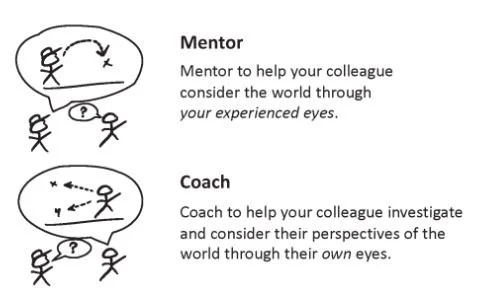
Note: Taken from Figure 1 by Winters, R. C., Chan, T. M., & Barth, B. E. (2024). Five hats of effective leaders: teacher, mentor, coach, supervisor and sponsor. BMJ Leader, 8(1), p. 10. https://doi.org/10.1136/leader-2022-000733
So, why not just pick a hat and wear it the entire time?
Well, each role has its limitations. According to Winters et al., a mentor’s experience informs their advice. But this becomes problematic when a mentor’s experience differs from the mentee’s. Race, gender, culture, socioeconomic status, citizenship, and other parts that make up our identities shape people’s experiences and, therefore, their working advice.
In other words, my experience and advice may not work for someone else.
At the same time, coaching also has its limitations. Winters et al. claim that coaching can be ineffective when coaches lack experience and knowledge. Furthermore, this can lead to “never-ending loops of questions” that result in minimal to no action.
So staying in a single role does not serve others as well. This is where trust, active listening, and professional judgment come into play. It begins with dialogue.
I would start by asking questions such as:
What do you hope to accomplish?
What do you hope students will learn?
What does progress look like to you?
What have you already tried?
Are you looking for a direct answer, or do you want to think it through together?
I just have to build that trust, listen to their needs, and decide how best to address them. There isn’t a right or wrong answer, but it’ll be my answer. What I do know is that moving between stances or putting on different hats will help me best meet someone else’s needs.
Or as Uncle Iroh would say: “It is important to draw wisdom from many different places. If you take it from only one place, it becomes rigid and stale.”
“Sometimes Life is Like a Dark Tunnel”
Although I want to be competent at many roles, I think my current strengths probably align more with coaching, particularly Cognitive Coaching.
According to Ellison and Hayes (2009), Cognitive Coaching focuses on metacognition, or thinking about thinking. Instead of directly answering questions or telling others what to do, I want to guide, ask questions, think aloud, and help them develop their decisions and thinking.
One of the goals is to help others self-manage, self-monitor, and self-modify. This would be clarifying goals, paying attention to their thinking and external environment, and evaluating their actions. The mission is to build their capacity to make their own professional judgments.
The reason why this style appeals to me is that it centers around empowerment, agency, and deep reflection. I used to want all the answers all the time, but now I’m learning that the world is too messy to have perfect solutions.
In a way, we are all blind and trying to lead each other.
Or as Uncle Iroh said, “Sometimes life is like this dark tunnel. You can't always see the light at the end of the tunnel, but if you just keep moving... you will come to a better place.”
“Who Are You, and What Do You Want?”

Earlier, I said I would come back to the image. In this particular scene, Uncle Iroh steps up and becomes more confrontational because he believes that’s what Zuko needs at the moment.
He challenges Zuko and shouts, “I’m begging you, Prince Zuko. It’s time for you to look inward and begin asking yourself the big questions. Who are you, and what do you want?”
I really like this scene because Iroh is usually level-headed, but here he raises his voice to show the gravity of the situation. It’s a change from being gentle or telling someone what they want to hear to challenging them and knowing how to navigate difficult conversations.
If I’m ever in these roles in the future, it will be important to start by listening to the teacher’s context, stories, identities, goals, strengths, areas of improvement, and preferred support style. After all, OSPI (2020) says mentors should recognize a mentee’s strengths and have them clarify their needs, goals, and areas of growth (p. 7).
If the person needs me to share knowledge, I can. If they need to talk things through, I can. If they want me to shut up, I can… I guess
I also know what I still need to work on. At the beginning, I mentioned that I don’t have the most teaching experience. I would still like to get more time in the classroom, spend more time collaborating with others, and learn how to build relationships based on trust. Before I teach, I need to learn.
Ultimately, neither role is about forcing someone else to change or trying to “fix” them. As ATE (2025) says, they center on personal, professional, and pedagogical development.
Just like Iroh, I want to know when to find that balance: knowing when to step in and when to step out, or switch hats. The point is not to decide who another person should be. I think it’s about helping them identify who they should be, what they want, and how to get there.
“Who are you, and what do you want?”
References
Association of Teacher Educators. (2025). Teacher educator standards (3rd ed.). https://www.ate1.org/uploads/1/4/5/7/145746398/ate_teacher_educator_standards_3rd_edition_-_final.pdf
HarryPotterFan. (2021, April 19). These 14 Uncle Iroh quotes from “Avatar: The Last Airbender” are honestly kind of life-changing. BuzzFeed. https://www.buzzfeed.com/nostalgicdog73/uncle-irohs-best-advice-in-avatar-the-last-airben-2iuxjrylc4
Ellison, J., & Hayes, C. (2009). Cognitive Coaching℠. In J. Knight (Ed.), Coaching: Approaches and perspectives. Corwin Press
Office of Superintendent of Public Instruction. (2020). Washington State standards for mentoring. https://ospi.k12.wa.us/sites/default/files/2023-08/standards_for_mentoring_2020_0.pdf
Winters, R. C., Chan, T. M., & Barth, B. E. (2024). Five hats of effective leaders: teacher, mentor, coach, supervisor and sponsor. BMJ Leader, 8(1), 9–14. https://doi.org/10.1136/leader-2022-000733
